Pages

Sunday, June 28, 2015

Working Smart: Evaluating Box Scores


The above snippet from an MLB box score is what "Average Joe" sees when he reads the newspaper each morning.

"Ah, yes, I see Pete Rose had another good night."

Perhaps another fan may more closely evaluate this box score and see that Esasky drove in two runs with two QABs, and did not record a single hit. That'a also a good night at the plate.

On the Padres' side of the box, one may notice that Tony Gwynn only had one knock. Surely a sub-par results evening for the greatest contact hitter since, well, Pete Rose. But what did Tony do in his other ABs? Did he hit two missiles right at a fielder? Did he advance any runners because of his advanced approach? Did he get aggressive with a two strike count and a runner on first, knowing that a strikeout would do less harm to his team's chances of scoring than would grounding into a double play? That's important.

The point is, we cannot truly evaluate the game in proper depth with a box score.

As you will see in this game, the first MLB game ever played, the same style of box score was used!

Thank goodness the box score has evolved...a little.

This 2010 box score below is a representation of a shift in our value system. Yes, folks, sabermetrics are taking over the world. Get over it. They're useful, efficient, provide accuracy and depth...and are here to stay.
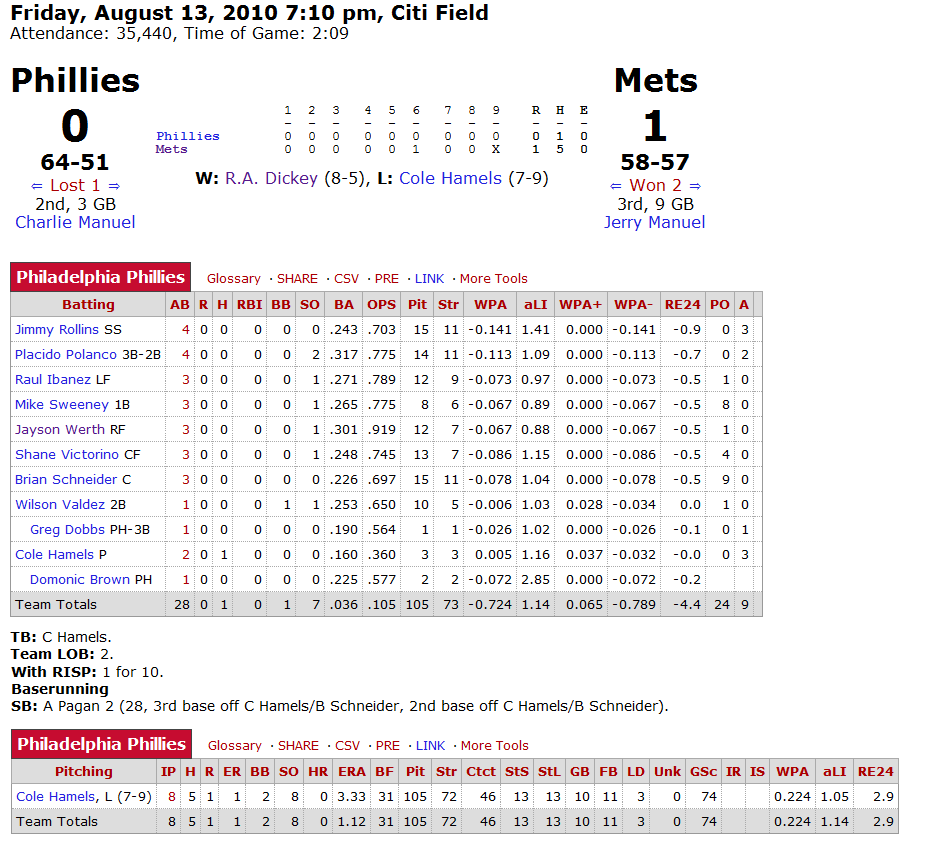


Now, we can see a player's advanced stats (those that have a higher correlation to success than does batting average or ERA). We also can see how many pitches a player saw in his collective ABs. 

This is vital. 

Imagine two players with equal stats are free agents. One hitter sees 4.2 pitches per plate appearance (PPA) while the other sees 3.4 PPA. Keep in mind they have nearly identical batting statistics. 

Sign the guy who makes the other team work! In order to win big games, most MLB clubs must be able to get to the bullpen as quickly as possible, regardless of the vaunted nature of the opposing club's bullpen. The ability to knock a pitcher out with an aggressive-under-control approach is valuable and has become a highly sought-after skill.

Evaluating a new age box score, we can also see:

1.) How poorly a team or individual does with runners in scoring position.
2.) A pitcher's game score (grading their performance in relationship to a perfect game- score 100)
3.) Defensive statistics
4.) Base running information previously unavailable i.e. which bases were stolen, and off of which pitcher/catcher combo.


But let's focus on the hitting aspect, for the sake of this blog. 


When you ask your players, teammates, coaches, friends, son or daughter...

"How did you do?"

How do they typically respond? 

"2 for 4." 
"0 for 3."
"1 for 5."

What we allow, we encourage. Stop allowing this stupid behavior! This is offensive suicide! We are programming our brains to be focused on and respond with results. Too many hitters are obsessed with their batting average, despite it's extraordinarily low correlation to runs created in comparison with OBP, SLG and hard contact percentage (barrels).

Look, results matter. But in hitting, results are best and most consistently found by focusing on:

1.) The process.
2.) What helps the team win.

Hit the ball hard. Swing at good pitches to hit. Take borderline pitches. Advance runners. 

Coaches and parents: measure, reward and celebrate QABs, PPA, OBP, OPS! These measurements are important to value because valuing them creates a mindset of aggressiveness, discipline, and controllables.


Saturday, June 20, 2015

Get Tough: Change and Grow


                                                                          (photo credit: bellinghamdistanceproject.com)


Everyone wants to be tough.

Many show toughness in small chunks, but they just aren't consistent.

We admire those who are consistently tough. They are relentless mental assassins. They assassinate negative thoughts. As the eloquent Macklemore wrote in his song titled 10,000 hours, "the greats weren't great because at birth they could paint; the greats were great because they paint a lot."

Malcolm Gladwell outlined the 10,000 hour theory in his book Outliers. You want to be a master at your craft, you say? For most, it takes an accumulation of 10,000 hours of training in that skill. The greats usually started young, but it's never too late to accomplish something great.

Mental conditioning is just like strength conditioning, you have to do something to get stronger. When lifting weights, muscle tissue that gets broken down repairs and regrows as bigger and stronger muscle (when observing proper rest, hydration and nutrition). Likewise, mental conditioning requires "breaking down" of our attitudes. Fortunately, this happens every day! We all have bad thoughts, attitudes and ideas. The key is knowing what to do with them, surrounding yourself with the right equipment, and growing!

Weight lifters can't have the same weight routines without reaching a plateau. The same is true in mental conditioning. We all must challenge, change, seek new knowledge, surround ourselves with new mentors, read new books, buy new audio tapes, and disable the systems that limit us.

Sometimes, growth cannot occur until we rid ourselves of our limiting beliefs or negativity that surrounds us, i.e. negative friends, co-workers, TV shows, movies, commercials, etc. These are all advertisements for our attitudes. If you're consciously working to become tougher, you've got to get rid of the junk.

Imagine you were working to lose weight, so you began lifting weight and running. But you kept drinking soda and eating potato chips. Eating healthy 80% of the time will get you marginal results. Thinking positively and aggressively 80% of the time will bring the same average results.

When you want to get tough, you must fear average.

Here are a few resources for improving mental toughness:

briancain.com
tonyrobbins.com
mentalgamevip.com
jongordon.com


Tuesday, June 16, 2015

Today's Plan for Improvement

                                                           
                                                                                           (Photo credit: zarachiron.com)

How will you get better today?

Excellence isn't quantum physics. Heck, it's not even trigonometry. It's not that tough! So many believe you have to do something massive or extraordinary to create success. Success begins with a step forward - kaizen - small and consistent improvements. Excellence is not as much about what you do but how you do it.

Focus on these items today, creating a short, written plan on how to attack them.

1.) Nutrition. You energy comes from what you eat and drink (and how well rested you are), so focus, truly focus, on what you are putting into your body. Take just five minutes each day and plan what you will eat today, or if you are really getting ahead, tomorrow. Temptation and bad choices are tough to avoid when we don't plan.

2).  Turn off your cell phone. Holy crap. Put it away.

3). Wear a watch and set an alarm for every 30 minutes. See how much you get done in that time. Did you get distracted? To invest your time, you must increase your awareness of time. When we feel like we have the whole summer, or all day, we don't value time. Keeping track of time will help you create greater return on your investments.

4). Cut out photos of people you want to be like, places you want to go, goals you want to reach. Advertise to yourself! There's a reason why companies pay millions of dollars for 30 minute advertising segments. Advertising works!

Thursday, June 11, 2015

Recruiting: Tools or Character?

                                                                 
                                                                                                    (photo credit: sfgate.com)


A professional scout asked me today, "which would you choose, tools or character?"

I paused. "Do I have to choose?"

"Well, are you willing to take someone who has baggage," he asked.

I have a lot of respect for this scout, and it was a well-intentioned question. He knows a former player of his (when he coached collegiately), that is transferring...with some baggage, and wants him to land in a place where can grow as a person and player.

I believe grace is important. Everyone needs a second chance at something at some point in their life. However, as I described to the scout friend of mine, I believe there is a difference between 1.) an attitude or energy problem and 2.) a choices or decision problem.

Players with bad attitudes and/or energy, in my experiences, don't often change their attitudes while they are in college. College offers more opportunities to make incorrect, immoral or just plain stupid choices. An attitude is not fixable by circumstance, provocation or by anything initiated by another. Attitude is a personal choice, and changing a bad one takes large personal change.

There are, of course, thousands of athletes who are good people with strong character backgrounds who are simply immature, sheltered, enabled or entitled. Often, these young men have made a stupid decision simply because they have been in an environment that has fostered bad choice/decision making. Give them an environment where they are surrounded by a team and coaching staff full of more disciplined, regimented and positively experienced people, and they will be led in a direction of better decision making.

We are all a compilation of the people we surround ourselves with. With so many distractions in college, it is important to choose wisely who we hang out, listen to and learn from.

Collegiate coaches clearly have the opportunity to build their programs through selection, i.e. recruiting. Intentionally inviting people into a culture that are unlikely or unwilling to change who they are as people is sheer lunacy.

So many coaches are allured by the talent, potential and other four letter words of a handsomely talented athlete. If an athlete has made a mistake, and clearly offers remorse, along with a plan of self-improvement and a passion for a fresh opportunity, without blame of others, he is clearly ready to receive grace. This athlete will be grateful for the opportunity presented to him and will be more coachable and energetic.

Let's not group all athletes with baggage into one boat. When recruiting, no one should choose talent over character, but coaches should understand and respect the difference between an athlete's flaw in decision and his lacking character.


Monday, June 1, 2015

Hitting Success in Summer Ball

                                                                                       (Photo credit: Wralsportsfan.com)

It's June 1st, and summer ball is all around. I mean, it's everywhere. Travel ball has 18u, 17u...heck they go all the way down to 8u. Little Johnny and Tommy are getting shuttled all around the country to play the best teams their tournament fees can buy.

At the collegiate level, summer wood bat leagues are already several games deep into the hot summer grind. While some hitters try to continue their hot streak from their spring seasons, others are happy to have a second Opening Day.

Let's get this straight: the summer is about development. 

No matter what age you are, it's not about as much about winning a summer championship (those are nice, too), as it is about personal development of your skills, your craft and developing committed hitting approaches.

Summer ball often provides an opportunity to see better pitching. Whatever league you are invited to play in will have an assembly line of pitchers who were among the best on their respective high school or collegiate teams. If you're a travel baller or high school hitter, you're likely seeing pitchers who have been bused or flown in just to face your team in pool play.

Facing pitchers that you have no scouting report on, in sizzling hot and muggy climates where exhaustion can creep in, with new teammates and coaches to prove yourself in front of, and a high school or college to represent...can create a lot of challenges and pressures. And as a collegian, your coaches have asked for you to improve on a skill or approach over the summer. Whew.

If you want to dominate this summer, heed this advice.

1.) Show up early. Earlier than everyone. Every day. Get better in the cages before the coaches ever show up for BP.

2.) Be process oriented. Focus on seeing the ball well and getting good pitches to hit.

3.) Play aggressively. No one plays well when timid or passive, especially against better competition.

4.) Develop self-awareness. The summer provides a more relaxed atmosphere for focusing on your thoughts, making adjustments and finding a way to improve. No one has homework in July.

5.) Invest your time. Buy a couple of good books. Buy a notebook and take notes on your at bats, pre-game and during game thoughts, etc. There are a lot of long road trips in the summer, and an iPhone, Xbox or Men's Fitness magazine are really just a brief waste of time. Everyone should have some down time, but in summer ball provides an enormous amount of down time. Invest that time into something that will give you dividends upon your return to school ball.

6.) Work out. Hard. So many players waste their opportunity to improve their strength, flexibility and athleticism because they are afraid of playing sore or just flat can't get off the couch. Set a plan into action with an aggressive growth goal and attack the weights or yoga !

7.) Have fun! Everyone wants an opportunity to play pro ball, and this is as close to playing every day as many will get. Enjoy the opportunity to play in front of big crowds at night, meet new teammates, invent new rain delay antics and learn more about this beautiful game and about yourself!


Wednesday, May 27, 2015

Plate Discipline


                                                                                (Photo credit: Diamondhoggers.com)

In 2012, 2013 and 2014, Bryce Harper had the following stats:

Year      PA      BBs   BB rate
2012      597        56      9.3%    
2013      497        61     12.2 %    
2014      395        38       9.6%  
2015      195        40     20.5%

Not surprisingly, Bryce Harper leads MLB with a 1.193 OPS, 42 RBI and a 4.1 WAR.

Certainly, pitchers are more careful with hitters who show consistent power, but 10% more careful?

Bryce Harper has become more selective. He is swinging at fewer pitches that aren't what he is looking for. He has improved his plate discipline.

Having great plate discipline means hitters swing at pitches they are on time for and take pitches that they cannot hit in that timing. No hitter can cover the entire plate and the entire depth of the hitting zone up and down, even if every pitch is a fastball.

When a hitter is looking to pull the baseball, the outside corner should be a take. Who cares if it's strike one or two. Putting the ball in play simply because it's a strike is a terrific way to induce an easy out at the collegiate level and above. Hitters simply reacting to a coach's 35-40 mph BP fastball and swinging "as long as it's a strike" are creating poor visualization and reactionary habits. They are teaching themselves to react to pitch tunnels and swing at pitches that they will not be able to cover once the pitcher is throwing 85+ mph.

I believe coaches can teach, preach and empower plate discipline in hitters. It is a skill, not a talent. The hitters who lead the league in walks are certainly talented, but they have acutely honed the skill of plate discipline. Seek and ye shall find.

Keeping track of batting practice is an outstanding way to measure plate discipline. Throughout the fall, we will measure:

1.) Strikes swung at
2.) Strikes taken
3.) Balls swung at
4.) Balls taken

It is not a batting practice pitchers job to throw every pitch in the strike zone. Conversely, it is not a hitters job to swing at every pitch thrown, so as to "keep BP moving." What do we really care about?

A timely BP or the development of our hitters? A great way to empower this is to take shorter rounds. Instead of 8 or 10 swings, try 4 or 5. Taking many swings is good for acquiring feel, but only if their is time between the swings to make adjustments, and energy with which to take the best hacks at each pitch.

Hitters who swing at 70% so that they can take 8-10 swings in a round are developing a feel for the barrel while moving slowly. Sprinters don't jog. Sprinters sprint. We, too, must train our hitters at full speed.

Now, what to do with this information we have acquired? Formulate percentages. Hitters who take too the highest number of strikes are not aggressive enough and operate in a mindset that each pitch must be too perfect. Hitters that swing at too many balls are reckless and lack discipline.

Many coaches may make the excuse that you can't make a kid more aggressive, but you can calm his aggressiveness. Noted. Let's start in batting practice. What we measure, they will value.

Plate discipline is simple. Hunt a pitch, be on time and take pitches that you aren't in rhythm with.

Saturday, April 25, 2015

Become a Better Hitter Immediately: Box Positioning

                                                                                        (Photo credit: risingapple.com)

Where a hitter stands in the box is crucial to his success. Proper box stance gives a hitter one of the few opportunities for adjustments that he can make.

Changing box position can allow a hitter to cheat to one side of the plate or the other, make the relative velocity of a pitch slower than it actually is, or change the elevation and height of a an incoming fastball or breaking ball.

Hitters with long arms should allow more space between themselves and home plate as they have more length in their swings, but also have better plate coverage, particularly on the the outside part of the plate. Shorter hitters shouldn't stand way off of the plate, as they won't reach the outside corner with consistency.

Box positioning is an important consideration when evaluating a scouting report. A team who knows that a pitcher is going to throw primarily off-speed pitches, should move up in the box to elevate the height of the off-speed pitches. Sure, this makes the fastball get on a hitter a tad faster, but this box positioning adjustment is made when a pitcher throws lots of change-ups or breaking balls with good depth.

Some pitchers unintentionally, yet consistently, elevate their fastball in the strike zone. These guys are tough to hit. Hitters feel like they have to cheat to the ball, and most college hitters have linear swing paths that don't allow their barrel to be flat enough, soon enough, to crush a truly elevated pitch. A change in box position, to deeper in the box, can make the relative velocity slower and the elevation of the pitch lower.

Any time a hitter faces a sinker-baller or submarine pitcher, it can be quite challenging to hit their fastball with downward depth. Moving towards the front of the batters box  takes away the majority of the depth of a sinking fastball.

Facing a pitcher with a plus 12-6 CB? Move up in the box and attack the fastball. The deeper you are in the box, the more like a strike the breaking ball looks to the umpire. If a hitter moves up in the box, he may get more breaking balls called as a ball high, crossing at the belly button, rather than at the belt.

Some pitchers don't have a ton of movement, but are wildly successful because they command pitches at the bottom of the zone, right at the knees. Don't just sit there and wear it for seven innings while their ace gets ground ball after ground ball! Move up in the box and get some pitches to hit at the quads.

Average hitters make game to game adjustments. Good hitters make at bat to at bat adjustments. Great hitters make pitch to pitch adjustments.