Pages

Saturday, January 23, 2016

How to Win Opening Day


(photo credit: 965thefox.com)

Opening Day is a beautiful thing. The grass is just the right height, the sun seems to always peek out from behind the clouds, and the heartbeats of hitters everywhere echoe throughout ballparks. 

Hitting is hard, but it is simple. Opening Day is no different. Here's a short take on how to hit your best, from the very start of the season. 

1.) Prepare every day like it's Opening Day. When you practice fast, practice with energy and crank the pulse up every day, you learn how to be in control of yourself when the game gets quick. 

2.) Hit what you are going to get. You're the 4 hole hitter. You hit 15 jacks last season. Sitting on first pitch fastballs all day doesn't make much sense. Understand how you would pitch yourself, and commit to those approaches. 

3.) Aggressive under control. Everyone with a pulse gets fired up for Opening Day. Many are so jacked up, they look like the Ultimate Warrior in Wrestlemania VI. Breathe. 1-2-3-4. One in, two out, three in, four out. Simple. Controllable. Now your body can attack the baseball without tension.

4.) Hunt elevation. So many pitches on Opening Day are left over the plate and elevated. Don't be in such a rush to do damage that you swing at the first fastball you see. Get a good pitch to hit.

5.) Stay committed to your approach/ get into that bullpen. If the pitch you are hunting isn't there, grind out a 5 or 6 pitch AB. Starting pitchers' stuff will wain quickly on Opening Day, and almost everyone's middle relief has lesser stuff than their starting staff. Get into that pen.

6.) Be early on any fastball you anticipate. Most hitters don't find themselves out in front of fastballs on Opening Day. We "just miss" and fly out to center field, foul it straight back or pop out to second base a mile high. Don't give away at bats because you miss good fastballs to hit.

7.) Visualize today as the 20th game of the season, and you are hitting .350/.450/.550. Envision the ball jumping off of your bat with extra-base-flight. When you feel like you've been swinging it well, you're much more likely to be in the present moment. Everyone loves the clean slate that Opening Day provides. Get a leg up on the competition by visualizing that you have already had a great start.

8.) Be TOUGH: hunt free bases. Early games are often won with BBs, HBPs and errors, not three-run homers. Toughness to stay in the box and toughness to get down the line on a routine ground ball or pop up can often mean one more run in any game, particularly early in the season.

9.) Seek to bunt. Defenses are most rusty in the first week of the season. Some teams haven't even been outside yet! Everyone has practiced catching weak fly balls. Challenge the opponent's defense.

10.) Routines: set them and stick to them. 

What will your routine be when you show up to the field on Opening Day? Do you plan to show up to the locker room at 9:50 when you need to be ready at 10? Create good habits that will allow for you to be in control and adjust to adversity. Those who are rushed create excuses. 

Be early, not on time. What about your pre-game hitting routines? How will you get loose? Shouldn't it be the same every day?

Think about your on deck routines. Does what you do create mental and physical preparedness for what will actually need to do in your AB? Do you take half-hearted swings that don't get you prepared. 

Work smart. Confidence will come from your preparation and your routines. 


Wednesday, December 30, 2015

A Great Teammate


                                                                                (photo credit: forbes.com)


A great teammate is an energy giver. You can trust a teammate who always gives energy. You know that he gives past the point of exhaustion, boredom and pain. 

A great teammate runs every ground ball and pop up out with 100% intensity. He comes early to the field. He stays late. 

A great teammate trusts himself and his teammates. He doesn’t curse after a bad at bat. He doesn’t make loud noises and hit things to draw attention to his own “care factor.” 

A great teammate encourages. A great teammate holds his teammates to the standards of the program. 

A great teammate communicates and asks questions. He isn’t afraid to be wrong, and isn’t afraid to fail. 

A great teammate keeps going. He is relentless.

A great teammate hustles to the field when he’s late from class. 

He has great focus in the dugout and on deck. 

A great teammate looks for tips and free pieces of information from the pitcher. A great teammate carries equipment that isn’t his, before a coach asks him to do so. He is selfless. He knows the team only grows more when he gives more. 

A great teammate communicates on defense, regardless of his age, talent or position. He isn’t afraid to say the wrong thing. 

A great teammate has perspective. He is enthusiastic, but not reckless. He is patient, but not passive. A great teammate cares about his brothers and shows his love with effort, intensity, energy and communication.

Are you a great teammate?

                                        (photo credit: active.com)

Saturday, December 26, 2015

How to Practice "The Zone"


The very best hitters have trained themselves how to shift in and out of a soft and hard mental focus. They use their routines, breathing, and self-talk to bring themselves into a peak mental state, primed for attack.

The best hitters are no more than momentarily deterred by bad calls, belligerent fans, bad swings, bad at bats, or other distractions, no matter the stage. Think about when you were playing your best, swinging a red-hot bat. The ball was more clear, the swing felt effortless, the ball exploded off the bat. This is the "zone."

Why can't we live in the zone? Why do most hitters not have their best years until their last years? Is it simply physical maturation? Surely not. Think of all of the freshmen All-Americans. What do they do so well? Even when scouting reports get out, those guys keep hitting.

Too many cage sessions include bad self-talk, bad body language and inconsistent focus as hitters worry about their mechanics. In order to have successful rounds in the cage, you must separate rounds where you 1.) Focus on mechanics, from rounds where you 2.) Quiet your mind and compete.

Hitters must practice getting into the zone. How?

Imagine an hour glass, like the one seen above. A human's ability to focus is best utilized in short, high bursts of attention. The human mind is easily distracted, and when a hitter's mind is distracted, his thoughts detract from his ability to execute the task at hand: hit the ball hard.

To physically practice getting into the zone, you must have the "4 R's" in what peak performance coach Brian Cain calls his system 4RIP3.

1.) Routines

Routines are the foundation of all success. - Ken Revizza

A routine gives you stability. Routines are what you do no matter how you feel and no matter how you are swinging, hot or cold. You create a routine, you believe in the routine and you always do the routine. The routine might include your footwork in setting up, touching your batting gloves, touching your helmet, tugging on your jersey, tipping your bat a certain way. This is part of the routine. Humans take pleasure in routine, and the stability they create gives us a calm, yet constant place to go to emotionally.

This place of habit, stability, comfort and calm, gives us our best chance, when combined with quality breathing and aggressive self-talk/intent, of staying in the zone.

                                                                                            (photo credit: cbssports.com)

The 2015 ABCA/Rawlings National Player of the Year Dansby Swanson, the number one overall pick in the MLB Draft, hit: .335/.423/.623 with 24 2B, 6 3B and 15 HR...and 54 K. Dansby wasn't perfect. But he was committed, aggressive and relentless. He knew how to breathe to re-center himself, and he could clearly communicate what he wanted to do with a pitch or inside of a sequence because he was under control emotionally.

And if you ask him, I bet Dansby would tell you that he practiced with intent. He competed during his BP rounds. Mechanical adjustments were off the field, and the zone was honed in the cages. By game time, he had a process of how to get himself into his highest level of peak performance, regardless of distractions.

The next part of the mental game is much easier when you always have a routine:

2.) Recognize
3.) Release
4.) Refocus

I won't dive into the three of these today. If you want more info from these, see my earlier post called "The Mental Game System: 4RIP3" posted January 18, 2014.

Work smart this winter! Acquire the skill that means the most. Practice your routines, dominate your routines, believe in your routines, and you will have your most consistent season ever. Spend 25% of your swings working on mechanics, 75% working on approaches/competing.

                                                                                                            (photo credit: mlb.com)


Friday, December 4, 2015

Have a Plan: Hit Smarter In the Cages This Winter


                                                                                            (photo credit: youtube.com)

Many hitters do not hit with an organized plan. They know they are going to hit today. That is their plan.

To be a good teacher, you have to have an organized plan. To become a stronger athlete, you have to have an organized weight training program. To become more fit, you need an organized nutrition plan. To rebuild a car, you need an organized plan. You get the point.

So, why do so many hitters hit with no plan and expect success? We call hitting the hardest single task in sport, and then show up to the gun fight with a sword.

To be a better hitter, we must practice intentionally.

We know the swing is important. A great swing maximizes bat speed, contact opportunities and assists good approaches. And no hitter can be consistent without a strong approach and ability to make adjustments. So, off to the cages we go to work on our swings, out bat speed, our contact and our approaches.

First, the average hitter gets loose with four or five swings, mixed with a couple of awkward half-stretches and back twists. Ah, there we go. After one hard contact and a couple of 6-4-3s, we're ready to really start hitting.

Let's back it up and start throwing to each other. Now is the time when many hitters "get on time for the fastball." Which one? One fastball velocity can have a relative velocity difference of up to 12 mph in the strike zone. An 85 mph fastball thrown down and away has a relative velocity of 79 mph while the same 85 mph fastball up and in has a relative velocity of 91 mph. Think you can sit on 85 and handle 91 and 79 in locations opposite to each other in the strike zone? Good luck. You may make contact, but you won't hit many balls hard. {For more information on relative velocity, see my previous posts "Box Positioning" (4/25/15) and "I Hate Slow Pitchers" (7/16/15).}

These types of cage hitting philosophies (or lack there of) are prime recipes for meddling in mediocrity and frustration. Don't be average, folks.

Let's create a plan. Every hitter should have a plan for what he is going to accomplish in the cage that day. That plan should be a progression from fundamentals to more challenging aspects of hitting, and can include mechanical focuses, varying approaches, changes in velocity, adjustment making, mental game training, strength training and vision training.

Quality of Swings

When you step into the cage, preset how many swings you are going to take. This innately makes the round competitive. You know how many swings you are taking and you will focus more on each repetition. The quality of the work immediately improves.

To start, cap a round at 12 swings. Elite hitters will take so much time between pitches to go through their routine, that they may only take one swing every 10 seconds. Most hitters take one swing every four seconds. This is an enormous difference in ability for the body to physically reset, and for the mind to refocus. Hitting is an anabolic movement. It's explosive. If you're swinging every four seconds, you must be trying to lose weight while you hit.

Instead of getting tired and pushing through, hoping to finish your round on a swing that makes you feel good, set parameters and goals for each round. When each round and each swing is competitive, the thought process and adjustment making between swings should become more intentional and game-like.

Approach 

Rather than just seeing it and hitting it, know whether you are looking for a fastball or an off-speed pitch. What are you sitting on? Then hunt one side of the plate or the other.

You cannot cover the entire plate. Sure, you can hit the baseballs thrown anywhere on the plate, but that shouldn't be your goal, should it? Desire to hit each ball with energy and aggressive flight into a gap. Let your misses be hard contacts that find holes.

Don't seek to make contact. You'll achieve that goal too easily, and create a manipulative, handsy swing that lacks bat speed, and commits to pitches at the same instance that it generates bat speed. Your outs will be pull-side on the ground and opposite field in the air. Sound familiar?

Making Changes/Level of Difficulty

If you are seeking to improve your swing, work off of the tee, and progress no further than front toss. If you can't master front toss with a swing adjustment, you will struggle against a live arm.

Once you have success against a live arm, increase the velocity to one that feels increasingly more stressful each round. Move the L-screen closer to the hitter, or have the BP pitcher throw harder. Eventually, we can work on the most challenging elements of hitting that mimic the most difficult game moments: high velocity/high spin fastballs, low and away fastballs, aggressive off-speed approaches and two-strike approaches.

If you have access to a pitching machine, this transition can be easy. If not, don't settle for the same old easy, feel good BP. That isn't building your swing, and it isn't challenging enough to truly build your confidence.


Note Taking

Many MLB hitters take notes. Some of them even do it in game. Taking notes allows hitters to retain more information, and to create a thesaurus of at bats, approaches, pitches, emotions, etc.

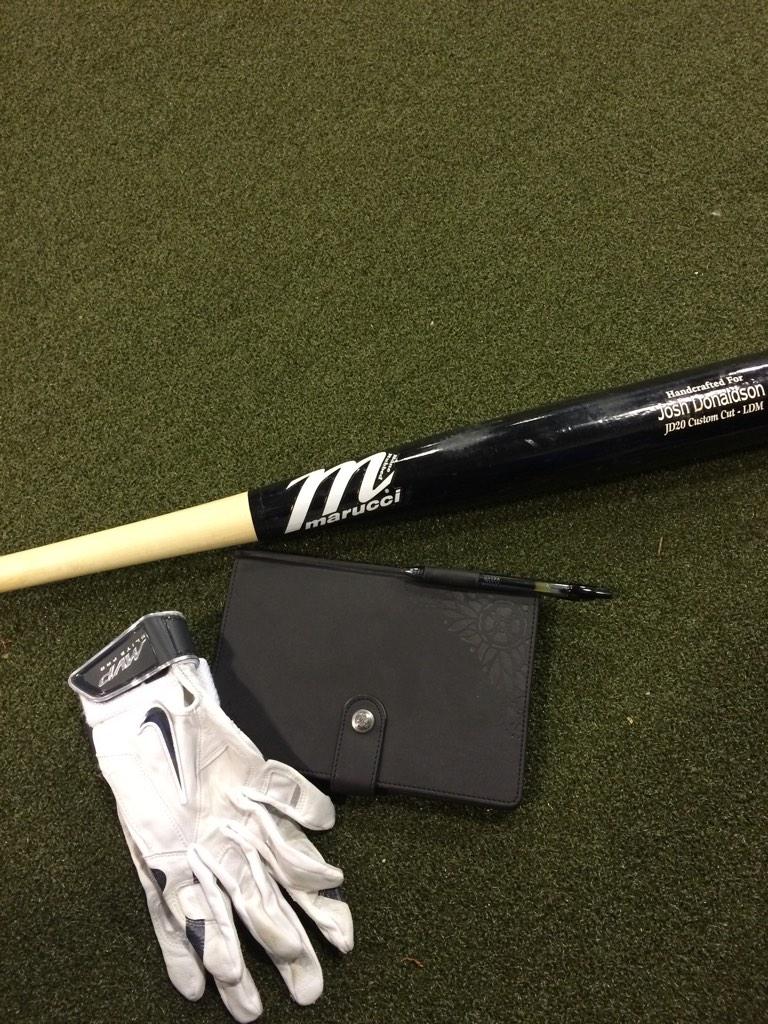
When you hit, take a note pad with you. This is Josh Donaldson's tweet from November 13th of last winter. Did he end up having a good season? What's an MVP?


This holiday season, be a giver. Give the gift of intelligence. Help your teammates work smart.

Be creative, be intentional, be prepared.


Saturday, November 14, 2015

Hitters: Getting Drafted


(photo credit: 27outsbaseball.com)


Nearly every little leaguer dreams of playing Major League Baseball. The president of Little League, Stephen Keener, notes that "for the 5,000,000 children playing baseball in the United States, 400,000 will play high school baseball. Of those, 1,500 will eventually be drafted by a Major League team (out of high school or college)."

To be drafted, a player must obviously have significant talent. He must possess electric speed, first class hitting ability, gorilla power, and/or outstanding defensive abilities. He must be projectable: his ceiling must be much higher than his current ability. 

Major League scouts are looking for ballplayers whom they believe can become big leaguers one day. They aren't looking for minor league fillers. Every scout wants to draft big leaguers, but they aren't looking for just one thing or another. Scouting is a complex web of evaluating talent, skill, work ethic, success, competition, character and signability. Those who are drafted possess most of those facets, not necessarily in that order.

There exists 30 MLB clubs with different general managers, scouting directors, advanced scouts, major league scouts, area scouts, cross checkers, special assistants to the GM and each of those 30 clubs has a different perspective on what they need, want, desire and actually draft. And each of those clubs may change their identity from time to time; baseball is as fluid as society. It is ever-evolving, hopefully for the better.

So what can a young man do to get drafted?

A hitter wanting to get drafted can control, in my estimation, about 10 % of the process. Here are a few controllables: 

The best hitters hit every day. They study their swings. They compete with resiliency and relentlessness. 

The highest drafted players are also consistent people. They are well spoken, can communicate their thoughts clearly, and have consistent control of their emotions. Usually, the highest drafted players are more mature. 

Big leaguers are professionals at nearly everything they do. Time management skills and the ability to focus are important for a big leaguer. These are skills that can be acquired for a young man.

Professional hitters are strong. They lift weights 4-6 days/week. They take care of their bodies by eating well and avoiding foods and substances that make them inconsistent or unpredictable. 

The best hitters know how to slow their minds down. They practice with laser like focus. They can consistently control their process, and thus, have consistently high results.

Finally, the best players focus on the team's success. If your number one goal this year is to get drafted, you're headed for a major let down. Selfishness is at the root of destruction. If you want to get drafted, focus on doing what you can do to help your team win. Make your team better. Make your teammates better. 


Saturday, October 17, 2015

The Big Game


                                                                                           (photo credit: nytimes.com)

Today's the big game. A rivalry game. An undefeated season on the line. Maybe today is a championship game. Or Scout Day. Today is the day you've been working toward for months. For you, for your team. Today is the big day. The big game.

What will I do to be special today? How can I step up? These are dangerous thoughts.

When the big game arrives, you have either put in the preparation, or you haven't. Players who perform consistently high in practices will have the confidence to perform consistently high in games. Players who perform well in regular season games should play with confidence in big games.

It doesn't take a Hall of Famer to tell you that the rules of the game haven't changed. A 90 mph fastball is still coming in at 90 mph. The requirements in approach and swing path are still the same. Why, then, do some struggle more than other in big games?

Hitters who have big game success have practiced at high speeds, have created intensity in their minds in regular season games, and know how to gain control and slow their minds down.

When the mind is slow, the body can react.

When our belief is that we have to do something different as a hitter, or if we feel unprepared, we get stressed and don't breathe as deeply. Muscles tighten, brain function slows just enough to affect clarity and precision. Results suffer. Ok, so we know we have to breathe well while in the midst of stressful competitions. What else can you do?

Visualize. The part of the brain that processes real information can differentiate those experiences from those that you vividly imagine. Practicing mental imagery creates confidence in preparation that never actually took place. Your brain can take you through scenarios that, when presented with similar real life images or information, feel familiar. Familiarity breeds calmness and confidence.

Here is a link to great info and instructions from Brain Cain on practicing visualization.

Great big game hitters also have perspective. Over-focusing on the meaning or importance of a scout day or a rivalry game creates a need to do well. When your body goes into fight or flight mode, your adrenaline and cortisol levels rise so high that your body's fine visual focus and manual accuracy are compromised.

The feeling of desperation can be helpful in athletics, but not in hitting.

Big moments require high energy, aggressiveness and instinct. But if you aren't playing with the same energy and intent every single day, you will feel the need to step up.

If the big game is wildly different in your mind than a regular game , your results will be compromised.

Tuesday, October 6, 2015

Symptoms vs. Problems.


When you get a cough, the cough isn't the problem. Your virus is the problem.

Many hitters diagnose their own swing problems incorrectly.For example, they believe their inability to stay through the baseball is a problem with their hands rolling over too soon.

What truly happened was that their center of gravity was too high or too far forward, disallowing them from retaining separation between their load and their stride, causing them to have less bat speed and their contact point to be too far forward. Then the hands rolled over.


                                                                                    (photo credit: dailyclimate.org)


There are many other examples. You all have heard the genius coaching tag line, "keep your head on the ball."

To the human eye, processing 30 frames per second, the collegiate or pro hitter appeared to yank his head pull-side in a desperate and futile effort to pull the baseball. What actually happens, when you analyze these swings with post-1980 technology, is that the hitter got beat. His body's natural reaction to making contact with the ball down the barrel, nearer the handle, was to evacuate the zone. Had he continued through with a normal swing path, his fingers would have felt as if they had been individually pulled from his hands, ringing with a sharp pain we all can remember.

Simply, when hitters feel mid-swing that they are beat, they pull every part of their body out of the zone in an attempt to salvage their hands, and perhaps, advance the ball more firmly than should they have continued on with natural extension.

Those are mechanical symptoms.

Even more challenging to evaluate, without proper communication with a hitter, are approach problems. Often these are misdiagnosed by the resident hitting guru as bad mechanics, or worse yet, the coach says the hitter "just doesn't know how to hit."

The student is often not the problem. Someone once said, "there are no such things as incapable students, only teachers who cannot properly communicate or adjust."

When a hitter is looking for an oppo FB and swings at a FB middle in, it looks like he has all sorts of swing flaws! His approach might have been good. But his commitment to his approach was the problem. His bad mechanics were a result, a symptom of the problem.

Many times, the mechanical problems begin with problems in the lower half. What should you look for? Start here:

1.) Center of gravity (high, low). High COG creates uncontrollable movement forward. The hitter isn't in control, gravity is. Timing is inconsistent. High COG creates more problems than a bull in a China shop. High COG is the most common mechanical problem I see in amateur hitters.

2.) Separation between stride and load. If their is no stretch in the bottom arm, there is no space to accelerate. Sure, you've got great barrel control, but with zero bat speed. Congrats on sucking.

3.) Hand path. Hitting coaches are notorious for talking about hitting with the hands, staying inside the baseball, etc. The reality is, if you create your bat speed by pushing your hands (linear hand path), you will be a low ball hitter, struggle with velocity IN and/or UP, and make most of your outs pull side on the ground and oppo in the air. You will lack your max ability bat speed, and will have to commit earlier than hitters who have elite swings.